Why LMS Implementation Is a Business Transformation Project
When organisations decide to implement a Learning Management System (LMS), the initiative is often positioned within HR or Learning & Development (L&D). This makes sense. After all, the platform is used to deliver training, manage learning programmes, and support employee development.
Hazie Halim
5/12/20264 min read
When organisations decide to implement a Learning Management System (LMS), the initiative is often positioned within HR or Learning & Development (L&D). This makes sense. After all, the platform is used to deliver training, manage learning programmes, and support employee development.
However, as many organisations begin their implementation journey, they start to realise something important – an LMS is not just an HR tool. It is a business transformation platform.
Because once the system is live, it begins to influence how people learn, how knowledge is shared, and how capabilities are built across the organisation. And those are not just HR concerns. They are organisational ones.
Beyond Training: How LMS Impacts Culture
Every organisation has a learning culture, whether it is intentional or not. Some environments encourage curiosity, knowledge sharing, and continuous development. Others treat learning as an occasional activity, often driven by compliance requirements.
An LMS has the potential to shape this culture.
When designed thoughtfully, the platform can encourage employees to explore learning regularly, share knowledge with peers, and take ownership of their development. Features such as learning recommendations, social learning, and accessible content can subtly influence how learning is experienced day-to-day. On the other hand, if the LMS is positioned purely as a compliance tool, employees may interact with it only when required.
Over time, these patterns shape behaviour. In this way, an LMS does not just deliver training. It signals what learning means within the organisation.
Supporting Capability Development at Scale
Organisations today are placing increasing emphasis on building capabilities rather than simply delivering training. Capabilities such as leadership, digital skills, and problem-solving are not developed through single courses. They require structured, ongoing learning experiences.
An LMS enables organisations to scale these efforts.
Through learning pathways, skill frameworks, and curated content, organisations can guide employees through development journeys aligned with business priorities. This shifts learning from isolated events to continuous capability building.
When implemented strategically, the LMS becomes a platform that supports workforce readiness, helping employees develop the skills needed not just for their current roles, but for future challenges as well.
Enabling Knowledge Sharing Across the Organisation
Knowledge exists throughout the organisation, often in places that are not always visible. Employees gain insights through projects, experiences, and collaborations. However, without the right platform, this knowledge can remain siloed within teams.
An LMS can help surface and share this knowledge more effectively. By enabling social learning, collaboration, and knowledge sharing, the platform allows organisations to capture valuable expertise and make it accessible to others.
This creates a more connected learning environment where employees can learn not only from formal programmes, but also from each other. Over time, this contributes to a culture where knowledge flows more freely across the organisation.
Why LMS is Not Just an HR Tool
When LMS is viewed solely as an HR system, its potential becomes limited. The platform may focus primarily on compliance training, course administration, and reporting requirements. While these functions are important, they represent only a small part of what the system can achieve.
In reality, an LMS intersects with multiple areas of the business:
Operations, by supporting workforce readiness
Leadership, by enabling development programmes
Strategy, by aligning learning with organisational goals
Employees, by supporting career growth and skill development
Because of this, the success of an LMS depends on broader organisational involvement, not just HR ownership.
The Role of Leadership and Strategy
For an LMS to truly function as a transformation platform, leadership support is essential. Leaders play a key role in shaping how learning is perceived within the organisation. When leaders actively engage with learning initiatives and encourage development, employees are more likely to follow.
Equally important is the presence of a clear learning strategy. Without a strategic direction, the LMS can easily become a repository of courses rather than a platform for capability development.
A strong strategy helps answer important questions:
What capabilities does the organisation needs to build?
How should learning support business priorities?
How can the LMS enable continuous development?
When leadership and strategy are aligned, the LMS becomes a tool that supports meaningful organisational progress.
A Platform for Transformation
Implementing an LMS is often seen as a technology project, but its impact goes far beyond system deployment. It influences how employees learn, how knowledge is shared, and how capabilities are developed across the organisation.
In this sense, an LMS is not just about managing learning. It is about shaping how the organisation grows. When approached thoughtfully, LMS implementation becomes an opportunity to create a more connected, capable, and learning focused organisation.
And while it may begin as a system rollout, it often becomes something much more meaningful. A quiet transformation in how people learn, work, and evolve together.
How Nixfon Learning Supports LMS as a Business Transformation Initiative
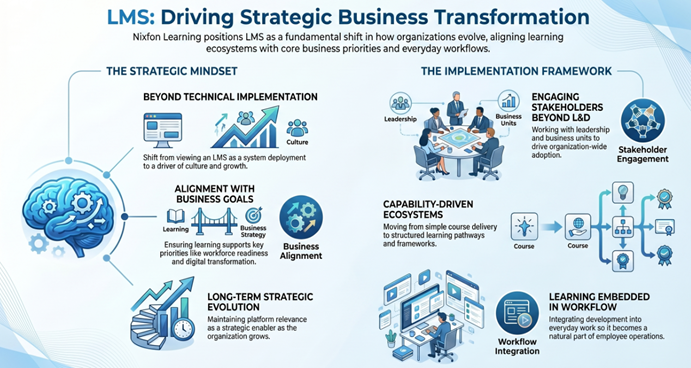
At Nixfon Learning, we recognise that LMS implementation is not just a system deployment. It is a shift in how an organisation learns, develops capabilities, and evolves over time.
Treating an LMS purely as a technical or HR initiative often limits its impact. When approached as a business transformation project, however, it becomes a powerful enabler of culture, capability, and organisational growth.
We partner with organisations to support this broader perspective, ensuring that the LMS is aligned not only with learning needs, but with business priorities.
We partner with organisations to support this broader perspective, ensuring that the LMS is aligned not only with learning needs, but with business priorities. Our approach includes:
We understand that transformation does not happen in a single moment. It happens gradually, through consistent decisions, aligned strategies, and meaningful experiences.
At Nixfon Learning, we walk alongside organisations on this journey, helping turn an LMS from a system that delivers training into a platform that quietly drives transformation across the business.
Till we meet again in the next episode!
About the author
Hazie Halim has more than 15 years of experience in Talent Management Solution and L&D Tech. Her approach has never been about the technology; it has always been about the people in the industry. She understands HR & L&D, she understands the pain and the stress, and she understands the fear and reluctance of system integration drama. Combining these has allowed her to be compassionate when sharing her experience and knowledge during project implementation. She is passionate about making the HR & L&D experts look good in front of their stakeholders. Their win is her win.


Unlock a world of thrilling content
Join our newsletter today
Resources
Unit 7.06, Level 7, Amcorp Trade Centre, 18, Persiaran Barat, 46050 Petaling Jaya, Selangor.
Nixfon (M) Sdn Bhd (633379-V)