
Virtual Coach: Smart Practice or Just Another Shiny Tool?
From difficult feedback to emotionally charged conversations, virtual coaching gives learners a safer way to practice before it counts. Explore the promise, the pitfalls, and the real value behind the technology.
Hazie Halim
6/11/20264 min read
Imagine this:
A manager sits quietly at his desk, staring at his calendar. 4:00 PM – 1:1 Performance Conversation.
He has been replaying his scenarios and conversations in his head multiple times. In the shower. In the car. During lunch. In every version, he either sounded too soft or too harsh. So, he does what most managers do.
He wings it.
And this, quietly, is where the most capability gaps live. Not in knowledge, but in rehearsal.
I’m sure, as L&D practitioners, you’ve seen this result many times. And as L&D practitioners, we have helped them by designing workshops, curating content, and building beautiful decks, so they have the materials on how to deal with this situation. But knowledge is not enough. They need more than just training materials to read. They need practice. They need to rehearse. But when it comes to practice and rehearsal, especially for hard conversations, we often rely on hope.
Hope that they will try. Hope that they will remember. Hope that it will end well.
This is where virtual coaching and virtual role play could really make a difference. Not as a replacement for humans, not as a futuristic toy, but as a rehearsal space.
Let’s talk openly and honestly about what that means.
First, what is a Virtual Coach really? It’s simple. It’s a safe practice environment. It allows employees to simulate conversations, receive structured feedback, and try again—no audience, no embarrassment, no judgment, no politics.
Think of it as a gym. You build muscle by repeating reps, not by reading about push-ups. And that is precisely why these matters.
Now, let’s dive into the pros (why it makes sense).
1) Practice without Ego
Face it, in real life, practice is expensive. You risk hurting relationships, damaging confidence, or escalating conflict.
Virtual role-play creates psychological safety. People can experiment. They can get it wrong. They can see what they missed. They can try again and again.
Skill grows faster when fear shrinks.
2) Consistent Objective Feedback
Managers may be too busy to coach deeply. Peers may soften feedback. Some learners may not even ask!
A virtual coach provides structured, criteria-based insights every single time. It does not get tired. It does not play favourites. And it does not avoid uncomfortable truths.
And to you, the L&D practitioners, this consistency is powerful.
3) Scalable Skill Building
Workshops are events. Skill development is a process.
Virtual coaching allows repetition over time. Weekly practice, scenario progression, and realistic situations that reflect your organisation’s reality.
Instead of one intense day of learning followed by silence, you create a rhythm.
4) Data that Actually Tells a Story
Imagine discovering that:
60% of your managers avoid direct feedback
Your sales team handles product questions well but collapses under emotional objections
Escalation conversations often lack empathy language
This is not training feedback. This is behavioural insight. And behavioural insight changes the way leadership listens to L&D.
The pros sure make you want to start jumping on the wagon, don’t they? But, if you aren’t careful, and if you start romanticising it too much, it can go wrong too quickly and too easily.
Now, let’s break down the cons, so you know how it can go absolutely wrong:
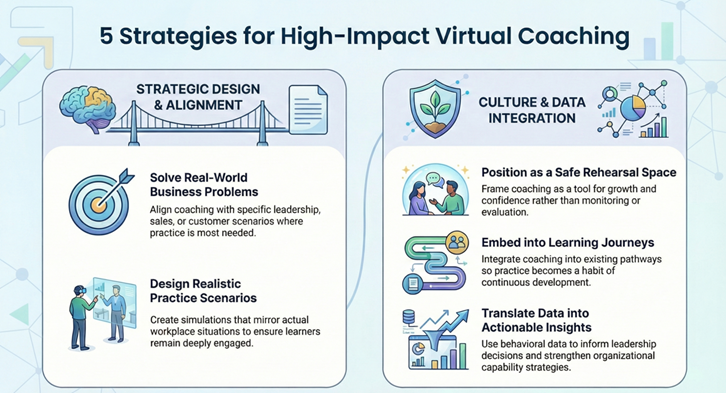
1) The Shiny Toy Syndrome
If you are only introducing a virtual coach because it sounds impressive and it makes you look cool, it will fade quickly.
Without a clear business problem to solve, it becomes an experiment with no anchor. Engagement drops and budget questions rise.
Technology cannot replace strategy.
2) Emotional Resistance
Some employees may feel monitored, evaluated, and judged. If positioned it poorly, it can feel like surveillance instead of support.
The narrative matters, and it must be framed as a rehearsal, not an assessment.
3) Poor Scenario Design
Generic scenarios lead to generic learning. If your simulations do not reflect real organisational tensions, learners will disengage.
Design matters more than the platform.
4) Data That No One Uses
Collecting behavioural insight is powerful but ignoring it is wasteful.
If L&D cannot translate insights into business language, the opportunity disappears.
As L&D practitioners, we often sit between ambition and limitation.
We know behaviour change takes time, and we know practice matters. We also know workshops alone are not enough.
Even though virtual coaching does not magically fix that, it gives us a lever. A structured way to embed practice. A consistent way to gather behavioural insight. A scalable way to support growth.
At Nixfon Learning, we often say learning should feel human before it feels digital. Virtual coaching, when it is done right, is not about artificial intelligence. It is about creating safer spaces for every real conversation.
And perhaps, the more important question is not whether your organisation needs a virtual coach. It is whether your people deserve a place to practice before it truly counts.
How Nixfon Learning Supports Virtual Coaching
At Nixfon Learning, we understand that introducing a virtual coach is not simply about activating a feature within an LMS. It is about thoughtfully embedding a new way for people to practice, reflect, and build confidence in moments that matter.
With platforms like Docebo offering virtual coaching capabilities, the opportunity is exciting. But without the right approach, it can quickly become just another underutilised tool. This is where we support organisations in turning potential into meaningful impact.
We recognise that virtual coaching works best when it feels human, purposeful, and relevant.
Till we meet again in the next episode!
About the author
Hazie Halim has more than 15 years of experience in Talent Management Solution and L&D Tech. Her approach has never been about the technology; it has always been about the people in the industry. She understands HR & L&D, she understands the pain and the stress, and she understands the fear and reluctance of system integration drama. Combining these has allowed her to be compassionate when sharing her experience and knowledge during project implementation. She is passionate about making the HR & L&D experts look good in front of their stakeholders. Their win is her win.


Unlock a world of thrilling content
Join our newsletter today
Resources


Unit 7.06, Level 7, Amcorp Trade Centre, 18, Persiaran Barat, 46050 Petaling Jaya, Selangor.
Nixfon (M) Sdn Bhd (633379-V)