LMS Implementation: Setting the Right Expectations for a Successful Launch
Implementing a Learning Management System (LMS) is often an exciting milestone for organisations. A new platform promises better learning access, improved reporting, and a modern experience for employees.
Hazie Halim
4/2/20264 min read
Implementing a Learning Management System (LMS) is often an exciting milestone for organisations. A new platform promises better learning access, improved reporting, and a modern experience for employees.
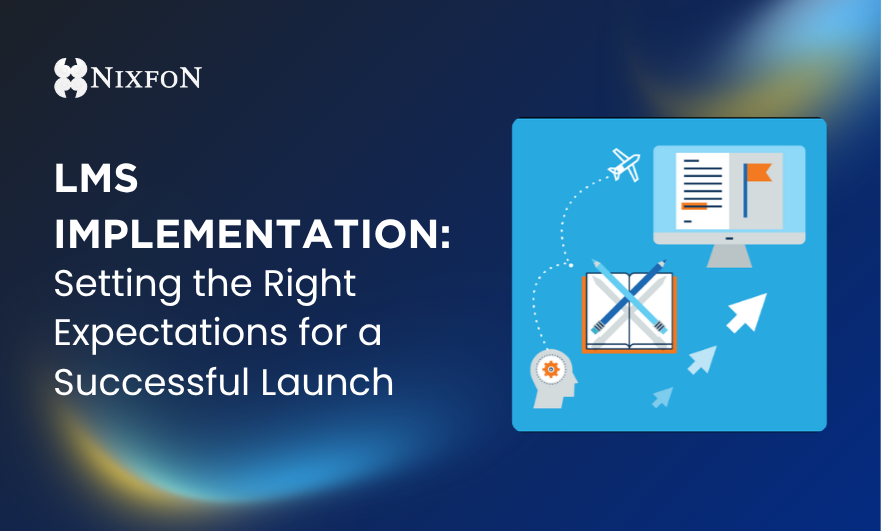
However, many organisations quickly discover that LMS implementation is not simply a technical deployment. It is a transformation in how learning is delivered, experienced, and sustained across the organisation.
Today’s LMS and LXP (Learning Experience Platform) have evolved far beyond administrative tools. They are designed to create meaningful learning journeys, encourage engagement, and support continuous development. Because of this shift, successful implementations must focus not only on system configuration but also on the learner experience.
When expectations are clear from the beginning, implementation becomes smoother, collaboration improves, and the platform is better positioned to deliver long-term value.
The Shift: From Administration to Learner Experience
Traditionally, LMS platforms were introduced primarily to manage administrative tasks such as course enrolments, compliance tracking, and reporting.
While these functions still exist, modern platforms place far greater emphasis on the learner’s experience. Features such as personalised learning paths, content recommendations, social learning, and mobile access are now central to how these systems are designed.
This means the goal of implementation is no longer simply to “launch the system”. Instead, the focus becomes:
How easily learners can find relevant content
How intuitive the platform feels to navigate
How learning aligns with capability development
How employees remain engaged in continuous learning
In other words, the system must work for the people who use it every day. Because of this, implementation projects now spend significant time on user journeys, communication strategies, and adoption planning, not just technical setup.
Roles & Responsibilities: A Shared Partnership
A successful LMS implementation is always a partnership between the organisation and the consulting team. Each party plays an important role in ensuring the project progresses smoothly.
The Organisation’s Role
Organisations bring essential knowledge about their workforce, culture, and learning priorities. Their responsibilities typically include:
Defining business goals and learning objectives
Providing timely feedback on system configurations
Preparing internal content and learning structures
Engaging key stakeholders and decision-makers
Supporting communication and change management
Strong internal ownership is critical. The LMS will ultimately become part of the organisation’s learning ecosystem, so internal teams must remain closely involved throughout the process.
The Consultant’s Role
Consultants guide the organisation through the implementation journey using their expertise and experience. Their responsibilities include:
Providing implementation frameworks and best practices
Guide on the platform configuration according to agreed requirements
Advising on learning architecture and user experience
Facilitating workshops and discovery sessions
Supporting testing, launch preparation, and early adoption
Rather than simply delivering a system, consultants help organisations make strategic design decisions that support long-term learning success. When both parties collaborate closely, the project becomes far more effective.
Common Implementation Dos and Don’ts
Over time, several patterns tend to appear across LMS projects. Understanding these early can help organisations avoid unnecessary complications.
Dos
Start with learning goals. Before configuring the system, organisations should define what they want the platform to achieve. Whether the focus is compliance, leadership development, or capability building, clarity helps guide system design.
Design for the learner journey.A well-designed homepage, clear learning pathways, and intuitive navigation make a significant difference in adoption.
Engage stakeholders early.Business leaders, HR partners, and learning teams should be involved in shaping the platform so that it reflects organisational priorities.
Plan for communication and launch support.A platform launch is also a change management moment. Clear communication helps employees understand why the system exists and how it benefits them.
Don’ts
Do not treat implementation as purely technical. Focusing only on system configuration often leads to low engagement later. The learner experience must remain central.
Do not migrate everything from the old system. Not all historical content needs to move into the new platform. Implementation is an opportunity to streamline and improve the learning catalogue.
Avoid unclear decision-making structures. Delays often occur when multiple stakeholders must approve decisions without clear ownership.
Do not underestimate internal readiness. Content preparation, stakeholder alignment, and change communication all require time and planning.
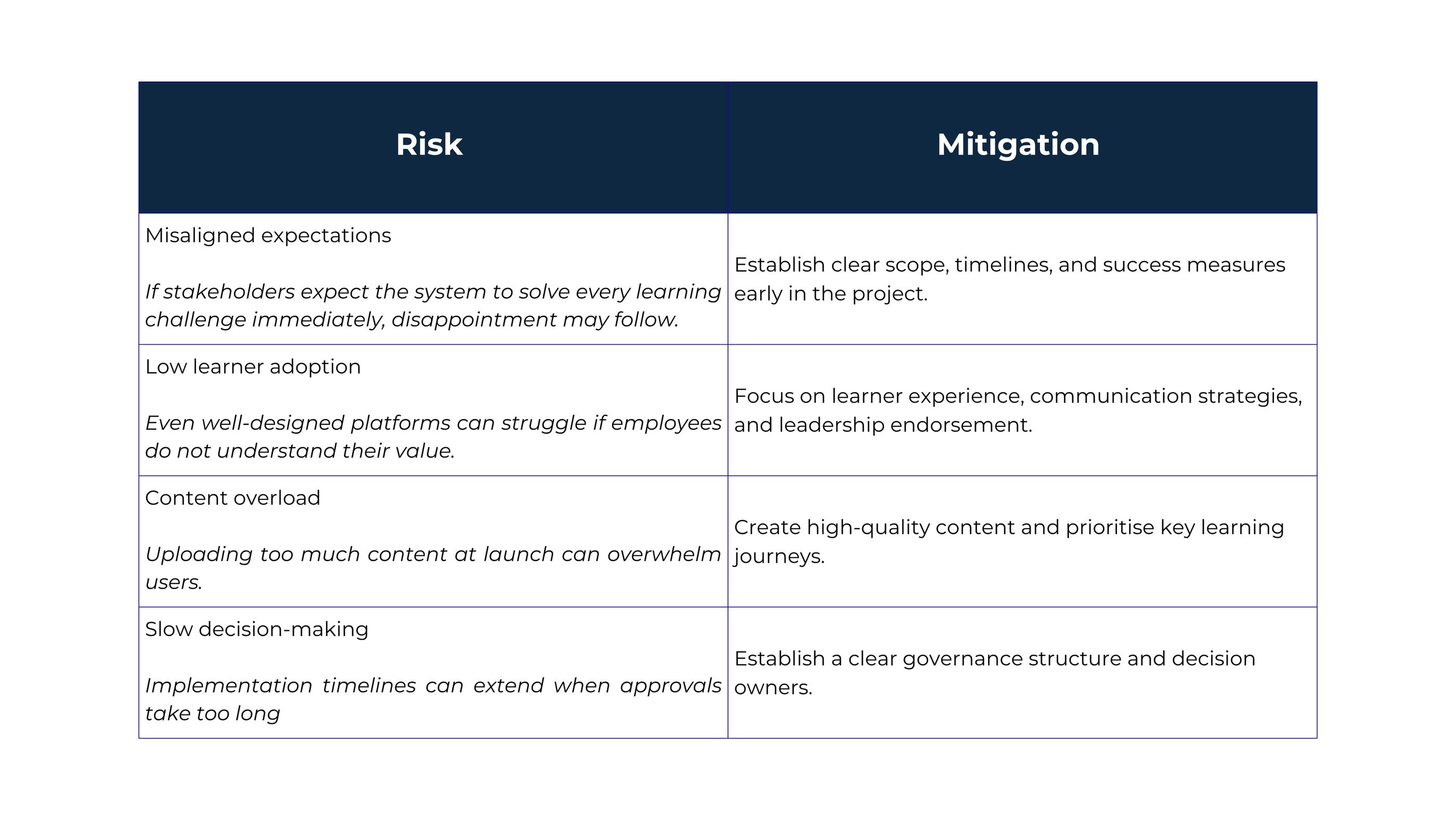
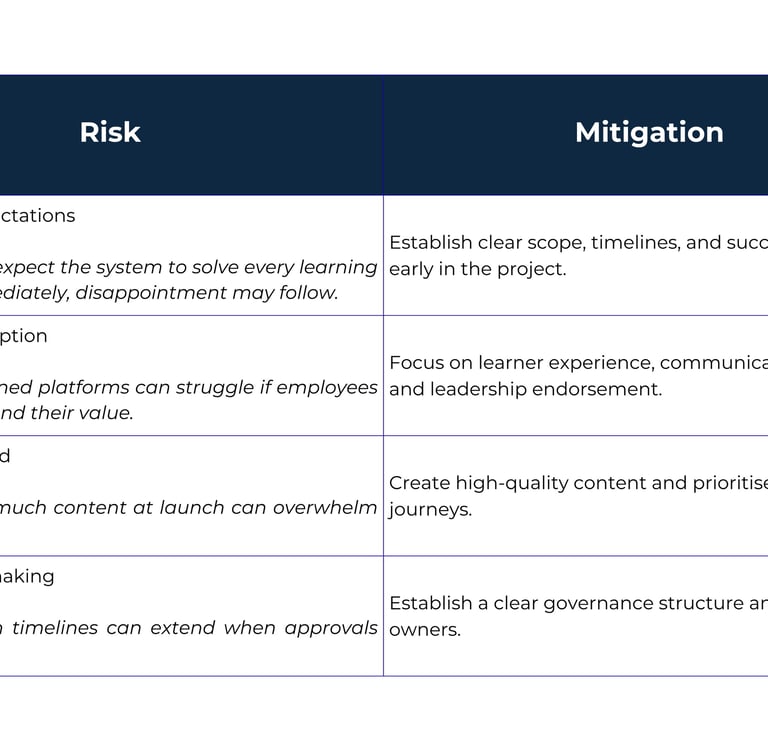
Understanding Risks and How to Mitigate Them
Like any organisational initiative, LMS implementation carries potential risks. Fortunately, most of these can be managed through early planning and collaboration.
How Nixfon Learning Supports a Successful LMS Implementation
At Nixfon Learning, we understand that a successful LMS implementation goes far beyond system deployment. It is about building a learning environment that works for your people, aligns with your business goals, and continues to evolve over time.
We partner closely with organisations throughout the entire journey, from discovery to post-launch optimisation, ensuring that every decision is purposeful and aligned to long-term success.
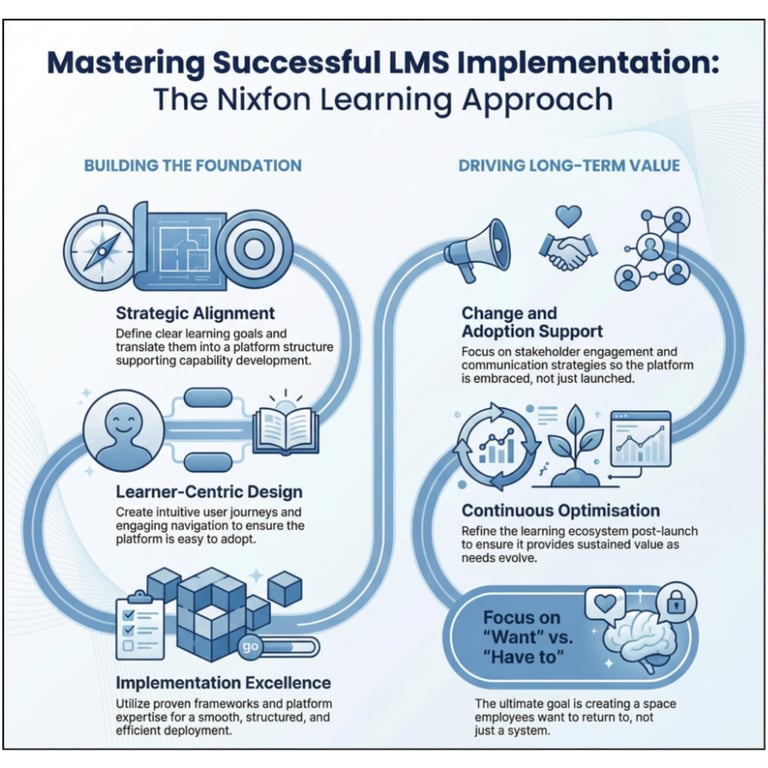
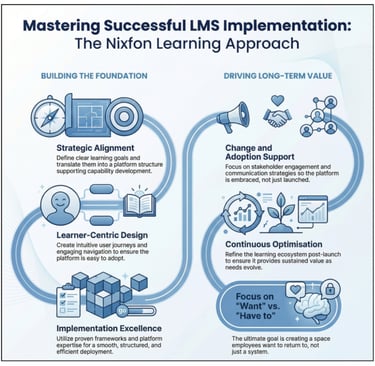
Ultimately, we believe that an LMS should not feel like a system employees have to use, but a space they want to return to. And when implemented thoughtfully, it becomes exactly that.
Till we meet again in the next episode!
About the author
Hazie Halim has more than 15 years of experience in Talent Management Solution and L&D Tech. Her approach has never been about the technology; it has always been about the people in the industry. She understands HR & L&D, she understands the pain and the stress, and she understands the fear and reluctance of system integration drama. Combining these has allowed her to be compassionate when sharing her experience and knowledge during project implementation. She is passionate about making the HR & L&D experts look good in front of their stakeholders. Their win is her win.


Unlock a world of thrilling content
Join our newsletter today
Resources


Unit 7.06, Level 7, Amcorp Trade Centre, 18, Persiaran Barat, 46050 Petaling Jaya, Selangor.
Nixfon (M) Sdn Bhd (633379-V)