LMS Implementation: Creating a Meaningful Learning Path
When organisations implement a Learning Management System (LMS), one of the most common approaches is to organise content into categories. Leadership courses go into one section, compliance training sits in another, and technical skills are grouped somewhere else.
Hazie Halim
5/7/20264 min read
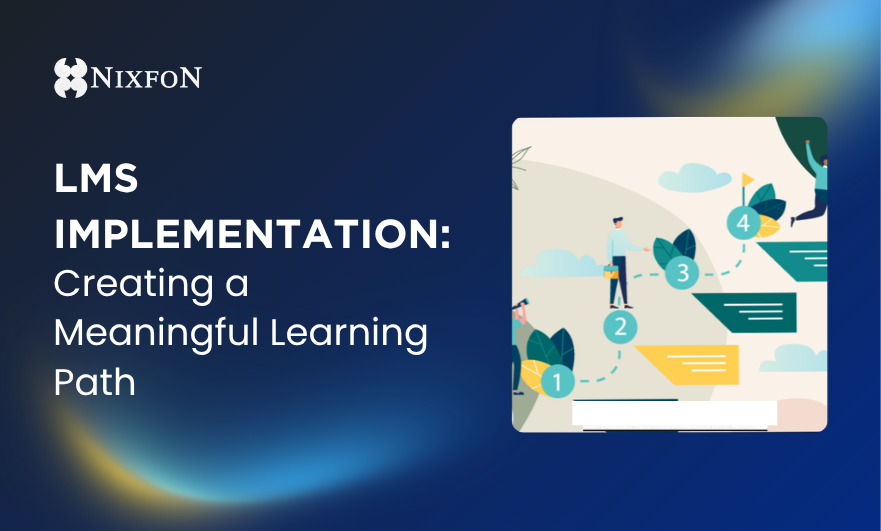

When organisations implement a Learning Management System (LMS), one of the most common approaches is to organise content into categories. Leadership courses go into one section, compliance training sits in another, and technical skills are grouped somewhere else.
On paper, this structure makes sense. It is tidy, logical, and easy to manage. But from a learner’s perspective, it often raises a quiet question: “Where do I even start?”.
This is where meaningful learning paths begin to matter. Because while courses are important, what learners often need is not just content. They need direction.
Why Meaningful Learning Paths Matter
A learning path is more than a sequence of courses. It is a thoughtfully designed journey that guides learners toward a specific outcome. Without learning paths, an LMS can feel like a library without a catalogue. Everything is available, but nothing is clearly connected. Learners may browse, click on a few courses, and then leave without a clear sense of progress.
Meaningful learning paths help solve this by answering three important questions for the learner:
1) What should I learn?
2) In what order?
3) What is this leading to?
When these questions are clear, learning becomes more intentional. Instead of randomly selecting courses, learners begin to follow a structured journey aligned with their role, goals, or development needs.
Enhancing the Learner Experience
One of the most immediate benefits of learning paths is the improvement in learner experience. A well-designed path reduces the effort required to navigate the platform. Learners no longer need to search extensively or decide between multiple options. The next step is already there, waiting. This simplicity can make a meaningful difference, especially for employees who already have full schedules.
Learning paths also create a sense of progress. When learners can see where they are in a journey and what comes next, it introduces a subtle but powerful sense of momentum. Even small progress feels visible and rewarding.
And occasionally, it prevents the all-too-familiar scenario of opening the LMS, browsing for five minutes, and leaving with the digital equivalent of “I will come back later”.
Designing Learning Paths that Make Sense
Creating meaningful learning paths requires more than grouping courses together. It involves understanding the learner’s context and designing journeys that reflect real development needs. Some practical approaches include:
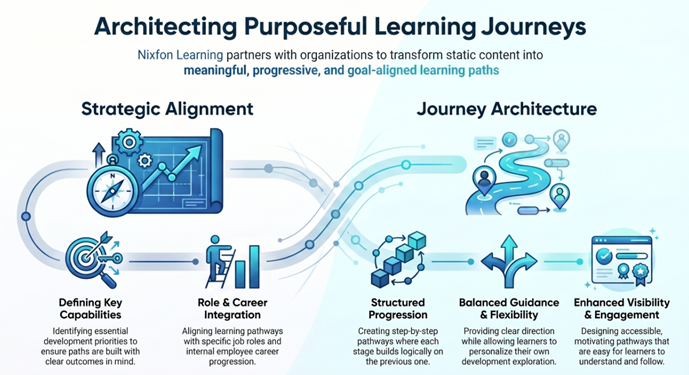
Role-based pathways – designed around specific job roles, helping employees build the skills required for their current responsibilities.
Career progression pathways – supporting employees as they prepare for the future roles or transitions within the organisation.
Capability-based pathways – focused on developing broader skills such as leadership, communication, or digital fluency.
Each pathway should feel purposeful and relevant. When learners recognise that a path aligns with their work or aspirations, engagement naturally increases.
Supporting Future Skills and Capability Development
Beyond improving the learner experience, learning paths also play an important strategic role. Organisations today are increasingly focused on building future-ready capabilities. This requires more than individual courses. It requires structured development journeys that support continuous growth.
Learning paths provide a way to organise development around skills and capabilities, rather than isolated training events. For example, instead of offering standalone leadership courses, organisations can design a leadership pathway that evolve over time, supporting employees at different stages of their development.
A Thoughtful Approach to Learning Design
Creating meaningful learning paths is both a design and a strategic one. It asks organisations to move beyond thinking about content as individual pieces and instead consider how those pieces come together to support a larger journey.
This does not necessarily require complex systems or extensive resources. Sometimes, a simple, well-structured pathway can be far more effective than a large catalogue of disconnected courses.
At its core, a meaningful learning path reflects a simple idea: learning should feel guided, not overwhelming.
From Content to Journey
An LMS filled with courses can provide access to knowledge. An LMS with meaningful learning paths provides something more. It offers direction, clarity, and a sense of progress.
When learners know where to begin, what to focus on, and how their development connects to their goals, the platform becomes more than a place to complete training. It becomes a space where growth feels intentional.
And in many cases, that small shift is what turns learning from an occasional activity into a continuous journey. Which, for most organisations, is exactly the destination they are aiming for.
How Nixfon Learning Supports Meaningful Learning Path Design
At Nixfon Learning, we understand that creating meaningful learning paths is both a strategic and human-centred process. It is not simply about arranging courses in a sequence, but about designing journeys that make sense to the learner and support real capability development.
Many organisations begin with strong content, but translating that content into clear, purposeful pathways can be challenging. This is where thoughtful design makes all the difference.
We recognise that a meaningful learning path should feel less like a checklist and more like a guided journey with a clear sense of purpose
At Nixfon Learning, we help organisations move beyond organising content to designing experiences, so that learners not only start their journey, but continue it with clarity and confidence.
Till we meet again in the next episode!
About the author
Hazie Halim has more than 15 years of experience in Talent Management Solution and L&D Tech. Her approach has never been about the technology; it has always been about the people in the industry. She understands HR & L&D, she understands the pain and the stress, and she understands the fear and reluctance of system integration drama. Combining these has allowed her to be compassionate when sharing her experience and knowledge during project implementation. She is passionate about making the HR & L&D experts look good in front of their stakeholders. Their win is her win.


Unlock a world of thrilling content
Join our newsletter today
Resources


Unit 7.06, Level 7, Amcorp Trade Centre, 18, Persiaran Barat, 46050 Petaling Jaya, Selangor.
Nixfon (M) Sdn Bhd (633379-V)