
LMS Data – Turning Learning Analytics into Business Insights
Modern Learning Management Systems generate a remarkable amount of data. Completion rates, login frequencies, learning hours, quiz scores, content views, and more. With just a few clicks, dashboards can produce colourful charts that appear impressively detailed. Yet many organisations quietly face the same challenge: they have plenty of learning data, but very little learning insights.
Hazie Halim
4/16/20264 min read
Modern Learning Management Systems generate a remarkable amount of data. Completion rates, login frequencies, learning hours, quiz scores, content views, and more. With just a few clicks, dashboards can produce colourful charts that appear impressively detailed. Yet many organisations quietly face the same challenge: they have plenty of learning data, but very little learning insights.
The difference matters.
Data tells us what happened. Insight helps us understand why it matters.
For L&D teams, the real opportunity lies not in collecting more numbers, but in translating learning analytics into meaningful business conversations.
What Data Actually Matters
It is easy to become overwhelmed by the amount of information available within an LMS. While every data point may serve a purpose, not all of them are equally valuable for strategic decision-making.
A helpful starting point is to focus on data that answers three simple questions: are learners engaging with the platform? Are they developing meaningful skills? Is learning contributing to organisational capability?
Some examples of useful learning data include:
- Learner engagement patterns such as social interactions and content interactions
- Skill development progress within learning pathways
- Adoption trends across departments or roles
- Completion of critical capabilities programs
These insights begin to reveal how learning is being experienced across the organisation. Interestingly, sometimes the most useful data is not what people completed, but what they searched for. A spike in searches around a particular skill can quietly signal emerging capability needs.
In other words, the LMS can function not just as a learning platform, but as a window into the organisation’s development priorities.
Moving Beyond Completion Rates
For many years, completion rates have been the most common metric used to evaluate learning programs. While completion data can be helpful, it tells only a small part of the story. After all, completing a course does not necessarily mean the knowledge has been applied.
Most executives intuitively understand this. If learning reports focus only on completion statistics, leaders may struggle to see the broader value of L&D initiatives.
Moving beyond completion rates allows organisations to explore deeper questions, such as:
Are learners returning to the platform voluntarily?
Are employees progressing through development pathways?
Are certain teams engaging more actively with learning than others?
These insights begin to paint a more meaningful picture of how learning contributes to organisational growth.
Linking Learning Data to Performance
One of the most powerful ways to elevate learning analytics is by connecting it with broader organisational outcomes.
When learning data is viewed alongside business metrics, it becomes easier to understand the real impact of development initiatives. For example, sales team completing product training may show improvements in sales performance, leadership programs may correlate with stronger employee engagement scores, or technical skill development may support faster project delivery.
These connections do not always appear immediately, and they often require collaboration between L&D, HR, and business teams. However, even small insights can help demonstrate how learning supports organisational capability.
When learning data is linked to real world outcomes, it shifts the conversation from training activity to business value.
Reporting Strategies for Executives
Executives rarely have time to analyse detailed learning reports. What they need instead is clarity.
Effective reporting focuses on a few meaningful insights rather than overwhelming leaders with dashboards full of numbers. Some helpful reporting strategies include:
Focus on Strategic Capabilities
Highlight how learning initiatives support the organisation key priorities, such as leadership development or digital transformation.
Show Trends Rather Than Snapshots
Executives are often more interested in how learning engagement evolves over time rather than single data points.
Translate Learning Activity into Business Context
Instead of simply stating that a program had 85% completion, explain how it contributes to workforce readiness or capability growth.Keep Reports Simple and Visual
Clear summaries and visual insights help leaders quickly understand the story behind the data.
From Data to Insight
An LMS produces data every day. The real question is what organisations choose to do with it.
When learning data is interpreted thoughtfully, it can reveal patterns in skill development, highlight emerging capability needs, and demonstrate how learning contributes to organisational progress.
For L&D teams, this shift represents an important opportunity. By translating analytics into meaningful insights, learning professionals move beyond reporting activities and begin contributing to strategic conversations. And occasionally, they may even rescue a report from the lonely fate of being downloaded once and never opened again.
Because ultimately, the goal of learning analytics is not simply to measure learning. It is to help organisations understand how learning supports their people, their capabilities, and their future.
How Nixfon Learning Supports Learning Analytics and Business Insights
At Nixfon Learning, we understand that having access to data is only the beginning. The real value lies in making sense of it, connecting it to business priorities, and turning it into insights that leaders can act on with confidence.
Many organisations already have rich learning data within their LMS but translating that data into meaningful narratives often requires a different level of perspective. This is where we support L&D teams in moving beyond reporting and into strategic insight generation. Our approach focuses on:
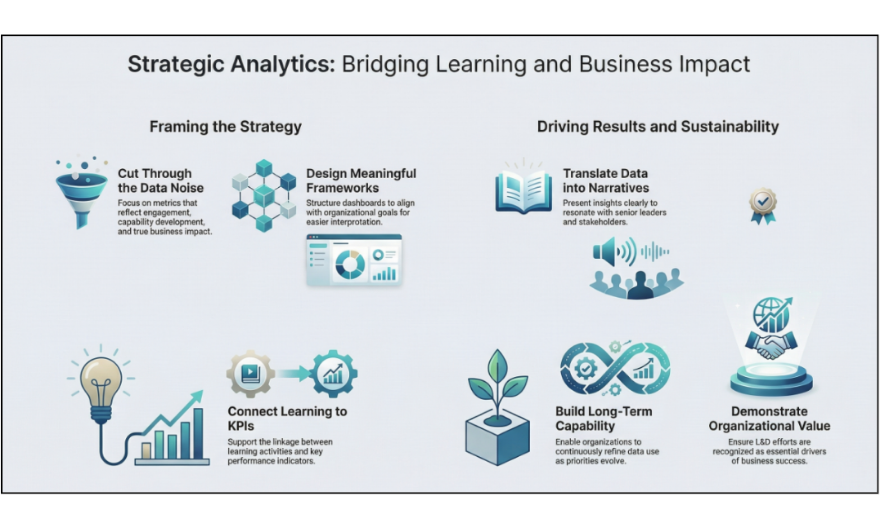
We believe that learning analytics should not feel like a collection of numbers, but a story about how people grow, how capabilities develop, and how organisations move forward.
At Nixfon Learning, we help bring that story to life.
Till we meet again in the next episode!
About the author
Hazie Halim has more than 15 years of experience in Talent Management Solution and L&D Tech. Her approach has never been about the technology; it has always been about the people in the industry. She understands HR & L&D, she understands the pain and the stress, and she understands the fear and reluctance of system integration drama. Combining these has allowed her to be compassionate when sharing her experience and knowledge during project implementation. She is passionate about making the HR & L&D experts look good in front of their stakeholders. Their win is her win.


Unlock a world of thrilling content
Join our newsletter today
Resources


Unit 7.06, Level 7, Amcorp Trade Centre, 18, Persiaran Barat, 46050 Petaling Jaya, Selangor.
Nixfon (M) Sdn Bhd (633379-V)