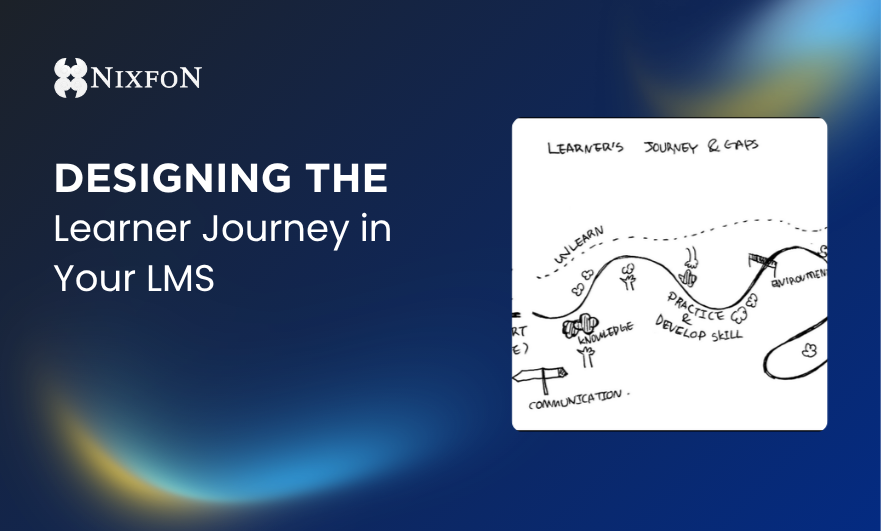
Designing the Learner Journey in Your LMS
When organisations implement a Learning Management System (LMS), the focus often begins with features. Does the platform support integrations? Can it generate reports? Is the dashboard modern and clean? These are important considerations, of course. But there is another question that matters as much and it is sometimes overlooked.
Hazie Halim
4/14/20265 min read
When organisations implement a Learning Management System (LMS), the focus often begins with features. Does the platform support integrations? Can it generate reports? Is the dashboard modern and clean? These are important considerations, of course. But there is another question that matters as much and it is sometimes overlooked.
What does the learning journey actually feel like for the learner?
Because at the end of the day, an LMS is not simply a system to manage courses. It is a place where employees come to explore knowledge, develop skills, and sometimes search for help 5 minutes before a meeting.
Designing the learning journey thoughtfully can make the difference between a platform that employees visit regularly and one that quietly gathers digital dust.
Mapping the Learning Journey
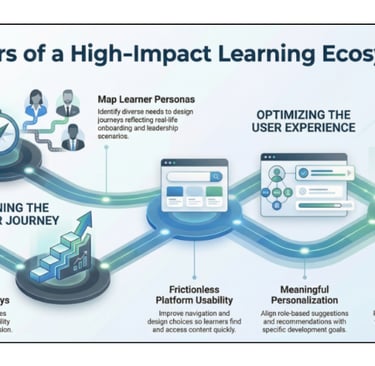
The first step in designing a meaningful LMS experience is understanding how learners interact with the platform. Think about the learner’s perspective:
A new employee logs in for the first time.
A manager wants to develop leadership skills
A sales team member needs quick product knowledge before a client meeting.
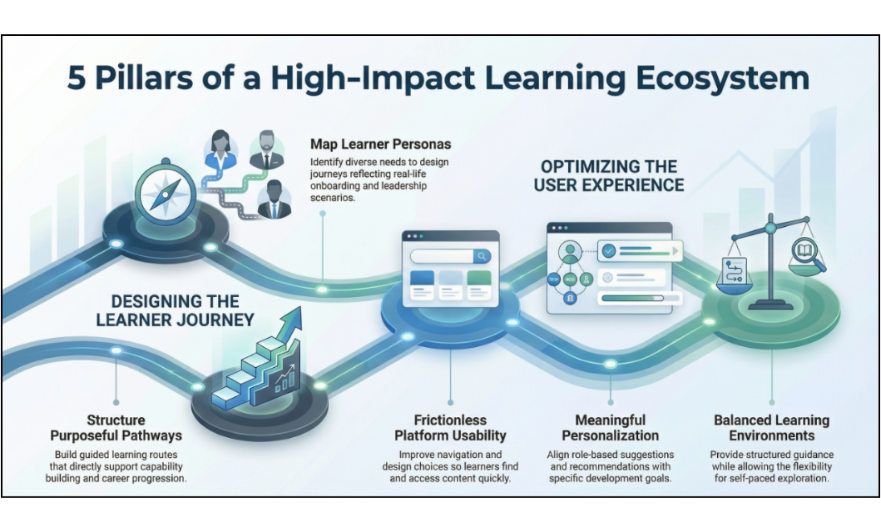
Each of these situations represents a different learning need. Mapping the learner journey helps organisations identify these moments and design experiences that guide learners naturally toward the right resources.
Rather than asking, “What courses should we upload?”, the better question becomes “what does the learner need to accomplish when they arrive here?”.
This small shift in perspective can significantly improve how the platform is structured.
Designing Intuitive Learning Paths
Many LMS platforms contain hundreds or even thousands of courses. While abundance may seem like a strength, it can also create confusion.
If learners must scroll through long catalogues to find something relevant, they may give up before learning even begins. Intuitive learning paths help solve this challenge.
Instead of presenting a long list of courses, organisations can design structured pathways that guide learners step-by-step through a developmental journey. For example:
New employee onboarding journey
Leadership development pathways
Role-based capability learning paths
These paths act like well-marked trails through a large learning landscape. Learners no longer feel lost in a jungle of content.
Reducing Platform Friction
One of the simplest ways to improve LMS adoption is to reduce friction.
Friction occurs when learners encounter small obstacles that make the experience more difficult than it needs to be. Sometimes, these obstacles appear as complicated navigation, unclear course titles, or too many clicks before reaching the content. Individually, these moments may seem minor. Collectively, they can discourage learners from returning to the platform.
Reducing friction often involves simple design choices:
Clear and familiar navigation structures.
Well-labelled learning categories
Easy search functionality
Short pathways to relevant content
When the experience feels effortless, learners spend less time figuring out the system and more time actually learning. And that, after all, is the goal.
Personalisation and Smart Recommendations
Another powerful way to enhance the learner journey is through personalisation.
Modern LMS platforms are increasingly capable of recommending content based on a learner’s role, interests, or previous activity. This transforms the platform from a static catalogue into a dynamic learning environment. When learners log in and see relevant recommendations, they feel understood. The platform begins to function more like a helpful guide rather than a library with no librarian.
Personalisation can include:
Role-based learning suggestions
Skill development recommendations
Suggested learning based on completed courses
Curated collections aligned with career growth
These features gently guide the learners toward meaningful development without overwhelming them with choices.
Why User Experience Drives Adoption
At its core, LMS adoption is not driven by technology alone. It is driven by experience.
If the platform is intuitive, relevant, and easy to navigate, employees naturally return to it. If it feels confusing or disconnected from their work, even the most powerful system may struggle to gain traction.
User experience influences how learners perceive the value of the platform. A thoughtful design communicates something important: “This learning environment was created with you in mind.” And when learners feel that the system supports them rather than demands their attention, engagement grows naturally.
A Learning Space That Works for People
Designing the learner journey requires empathy. It asks organisations to step into the shoes of employees who may already have full calendars, tight deadlines, and limited time for exploration.
A well-designed LMS respects this reality. It helps learners quickly find what they need, discover new opportunities, and move forward in their development without unnecessary friction.
When the learner journey is thoughtfully designed, the LMS becomes more than a course management system. It becomes a space where learning feels approachable, useful, and occasionally even enjoyable.
And if learners return to the platform not because they have to, but because they want to, then the design has done its job rather well.
How Nixfon Learning Supports Designing the Learner Journey
At Nixfon Learning, we believe that a well-designed LMS is not defined by the number of features it offers, but by how naturally learners can move through it.
Designing the learner journey requires more than organising content. It involves understanding how people think, what they need at different moments, and how to guide them without overwhelming them. This is where many organisations need a thoughtful partner to translate learning goals into meaningful experiences.
We work closely with L&D teams to design learner journeys that feel intuitive, relevant, and aligned with real work contexts. Our support includes:
We understand that designing a learner journey is both an art and a strategy. It requires empathy for the learner, clarity of purpose, and careful attention to detail.
At Nixfon Learning, we partner with organisations to shape LMS experiences that feel less like navigating a system and more like following a well-designed path.
Because when the journey feels right, learners do not just arrive. They continue walking.
Till we meet again in the next episode!
We understand that designing a learner journey is both an art and a strategy. It requires empathy for the learner, clarity of purpose, and careful attention to detail.
At Nixfon Learning, we partner with organisations to shape LMS experiences that feel less like navigating a system and more like following a well-designed path.
Because when the journey feels right, learners do not just arrive. They continue walking.
Till we meet again in the next episode!
About the author
Hazie Halim has more than 15 years of experience in Talent Management Solution and L&D Tech. Her approach has never been about the technology; it has always been about the people in the industry. She understands HR & L&D, she understands the pain and the stress, and she understands the fear and reluctance of system integration drama. Combining these has allowed her to be compassionate when sharing her experience and knowledge during project implementation. She is passionate about making the HR & L&D experts look good in front of their stakeholders. Their win is her win.


Unlock a world of thrilling content
Join our newsletter today
Resources


Unit 7.06, Level 7, Amcorp Trade Centre, 18, Persiaran Barat, 46050 Petaling Jaya, Selangor.
Nixfon (M) Sdn Bhd (633379-V)