Content Strategy for LMS Implementation: Quality Over Quantity
When organisations implement a new Learning Management System (LMS), one question appears almost immediately: What should we migrate into the new platform?
Hazie Halim
4/23/20264 min read
When organisations implement a new Learning Management System (LMS), one question appears almost immediately: What should we migrate into the new platform?
The instinctive answer is often simple: everything. Every course, every video, every document, every training module accumulated over the past decade suddenly feels important enough to bring along. After all, someone once created it, which must mean it deserves a place in the new system.
However, experienced LMS implementations often reveal a different truth.
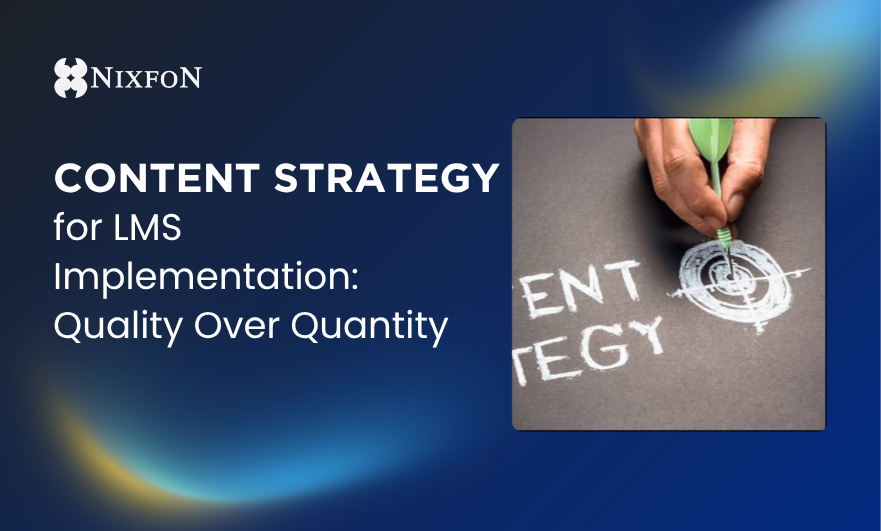
Migrating everything into a new platform rarely improves learning. In fact, it often creates confusion. A thoughtful content strategy helps organisations shift the focus from how much content exists to how useful that content actually is for learners.
Why Migrating Everything Is Often a Mistake
Many organisations have been producing learning content for years. Over time, libraries grow large and complex. Materials are often stored across different systems, folders, and repositories. When the time comes to implement a new LMS, these collections can easily contain hundreds or even thousands of learning assets.
While it may feel efficient to move everything into the new system, doing so introduces several challenges:
Learners face overwhelming course catalogues
Outdated content remains visible
Duplicate or similar materials compete for attention
Important learning resources become harder to find
In other words, the platform becomes crowded before learners even begin exploring it.
An LMS should ideally feel like a well-organised learning environment, not a storage archive for historical training materials. Sometimes the most strategic decision is not what to migrate, but what to leave behind.
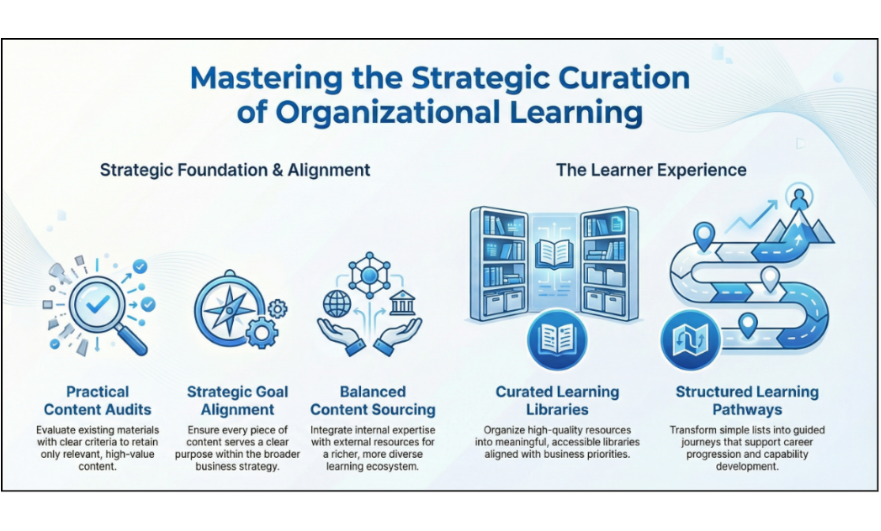
Conducting a Practical Content Audit
Before migrating content, organisations benefit from conducting a content audit. A content audit simply means reviewing existing materials and asking a few practical questions:
Is this content still relevant today?
Does it support current business capabilities?
Has the information become outdated?
Is there similar content already available elsewhere?
Through this process, content typically falls into three categories:
Keep – valuable resources that remain relevant
Update – useful content that requires refreshing
Retire – materials that are no longer serve a meaningful purpose
This exercise often leads to an interesting discovery: a smaller, well-curated library can deliver far more value than a large collection of rarely used courses.
Think of it as organising a bookshelf. A thoughtful selection of meaningful books often feels far more inviting than a wall of titles no one has opened in years.
Building Curated Learning Libraries
Once content has been reviewed, organisations can begin shaping a curated learning library. Curation focuses on selecting high-quality learning resources that genuinely support employee development. These resources may come from multiple resources:
Internal training programmes
External learning providers
Microlearning resources
Industry knowledge materials
The goal is not simply to gather content but to guide learners toward useful knowledge.
Curated collections help learners quickly identify valuable materials without feeling overwhelmed by endless choices. A well-curated learning library acts almost like a helpful guide, quietly pointing learners toward the most relevant resources for their growth.
Moving from Course Catalogues to Learning Pathways
Another important shift in LMS content strategy involves moving beyond traditional course catalogues.
Many learning platforms still rely on long lists of courses organised by category. While this structure works for storing content, it does not always help learners understand how their development should progress.
Learning pathways provide a more thoughtful approach. Instead of presenting isolated courses, pathways organise content into structured journey aligned with specific goals. Examples may include:
Onboarding journeys for new employees
Leadership development pathways
Skill-based learning tracks
Role-specific development programmes
These pathways help learners understand not only what to learn, but what to learn next. When learning is structured in this way, the platform becomes easier to navigate and more meaningful to use.
Creating a Learning Experience That Works
At its best, an LMS should not feel like a digital warehouse filled with courses. It should feel like a well-designed learning environment where employees can quickly discover useful resources, develop skills, and continue growing in their roles.
Achieving this experience requires thoughtful content strategy.
By auditing existing materials, curating meaningful resources and organising learning into clear pathways, organisations can transform their LMS into a platform that genuinely supports development.
And occasionally, it also means letting go of a few training videos created in 2012 that were considered groundbreaking. After all, the true strength of a learning platform is not measured by the number of courses it contains.
It is measured by how effectively those courses help people learn.
How Nixfon Learning Supports Content Strategy for LMS Success
At Nixfon Learning, we understand that content strategy is one of the most critical, and often underestimated, elements of successful LMS implementation. It is not about how much content is available, but how effectively that content supports learning, capability building, and real workplace needs.
We recognise that many L*D teams inherit large volumes of legacy content, each with its own history and intention. Making sense of it all can feel like opening a long-forgotten storage room where everything seems important, yet not everything is useful.
This is where we support organisations in bringing clarity and structure to their learning content. Our approach includes:
We believe that a strong content strategy transforms an LMS from a repository into a purposeful learning environment. One where learners are not overwhelmed by choice but guided toward what truly matters.
At Nixfon Learning, we partner with L&D teams to make those decisions thoughtfully, so that every piece of content earns its place and contributes to meaningful learning experiences.
Till we meet again in the next episode!
About the author
Hazie Halim has more than 15 years of experience in Talent Management Solution and L&D Tech. Her approach has never been about the technology; it has always been about the people in the industry. She understands HR & L&D, she understands the pain and the stress, and she understands the fear and reluctance of system integration drama. Combining these has allowed her to be compassionate when sharing her experience and knowledge during project implementation. She is passionate about making the HR & L&D experts look good in front of their stakeholders. Their win is her win.


Unlock a world of thrilling content
Join our newsletter today
Resources


Unit 7.06, Level 7, Amcorp Trade Centre, 18, Persiaran Barat, 46050 Petaling Jaya, Selangor.
Nixfon (M) Sdn Bhd (633379-V)